


How EV Winter Performance Has Improved in 2026
.avif)
Corey Cantor

We are now well into the winter season, which brings up the inevitable question: how do electric cars fare when the weather is cold?
The ZETA team previously published a blog post highlighting tips for navigating winter driving, including pre-heating the vehicle, storing the car in a garage if possible, mitigating range loss, and heating the vehicle efficiently. Those tips still hold up today, so it is a good place to start for drivers thinking about how to enhance their range.
All vehicles—regardless of drivetrain— experience range or performance loss in colder weather months. Conventional vehicles also experience range loss, though it may not be as apparent on the fuel gauge compared to percent range.
Still, progress continues in the electric vehicle space and there are some recent innovations and improvements that are worth highlighting. Many of these innovations are found in the newest models available, but that doesn’t mean your existing EV can’t also benefit from some of these improvements.
Pre-Conditioning for Public Charging. Electric vehicle batteries charge best when they’re already warmed up. This process is commonly known as ‘pre-conditioning.’ Pre-conditioning means warming the battery to the ideal temperature in order to operate and charge. In some cases, it refers to charging your vehicle at home and warming it up via home-charging. In other cases, it means warming up the EV battery prior to the utilization of a public fast charger. Drivers are able to pre-condition in many cases through the use of a phone application, or it will automatically occur by selecting a public charger in the vehicle’s navigation as a destination. Some older EV models may not be able to pre-condition through these active means.
.png)
In recent years, a common piece of advice for ensuring faster public charging has been to ensure that your battery is pre-conditioning for 15-20 minutes prior to charging. In fact, in some EVs, you won’t be able to charge right away at a public charger if the battery has not warmed up to the point where it is ready to plug-in.
Many EVs released in recent years will automatically begin pre-conditioning when a public charging location is selected on the vehicle’s internal navigation. It can also be started manually through some vehicles’ infotainment systems or apps. While preconditioning uses a small amount of power, , this is more than offset by e the far smoother, quicker fast-charging experience in these cold weather conditions. InsideEVs highlighted a Tesla owner in the cold climate of Sweden testing his public charge of a Tesla Model Y (from 10% capacity to 80%) after pre-conditioning versus minimal conditioning. The test found that pre-conditioning sped up the EV charging time at a supercharger by about ten minutes.
Improvements in EV models (including heat pumps). The latest generation of EV models is improving their performance in winter weather. Whether it’s the installation of heat pumps, which more efficiently provides heat to the cabin, better battery encasement, or smarter weatherization in the cabin, we are seeing less range loss for newer EVs. EVs lose range in cold weather for two main reasons: the chemical reactions in a battery slow when weather is colder, and additional energy in the car goes towards controlling the climate of the vehicle to ensure that the customer is comfortable. These improvements address both challenges.
Recurrent Auto has been conducting a winter weather survey utilizing data from 30,000 electric cars. It found that vehicles driving in 32℉ (Fahrenheit) weather retained, on-average, around 78% of that vehicle’s range. This is compared to the same vehicle’s range at an ideal driving temperature for the battery (70-80℉). For comparison, an internal combustion engine (ICE) vehicle in 20℉ loses around 15% of its range (in the case of a gas car this would mean less than its typical miles-per-gallon). For shorter trips, fuel economy loss for ICE vehicles could be as high as 24%. Hybrid vehicles also see a hit to fuel economy in cold weather, due to the combination of impact on their battery and gas engine.
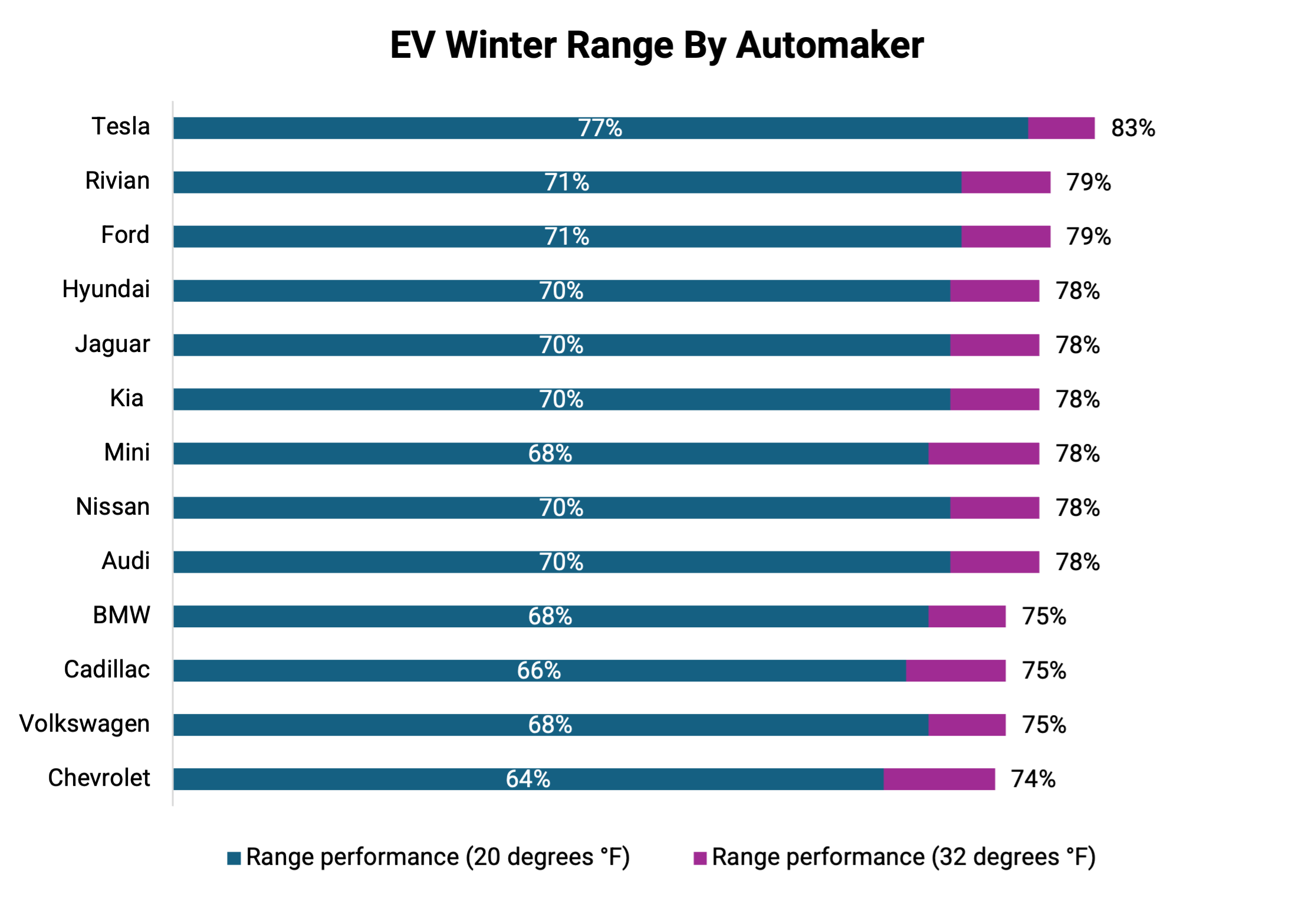
A recent piece by Auto Blog highlights additional improvements to electric vehicle models that enhance winterization. The author, Kristen Brown, notes that many newer EV models utilize artificial intelligence software to maximize the battery to heat an EV while maintaining battery health and have added new metals within EV batteries to better insulate the battery and spread heat to the vehicle.
Improvements to EV charging station sites. It’s important to note that many EV charging sites are improving their weatherization to operate across a wide range of temperature and weather conditions. ABB E-Mobility’s fast chargers, for example, can operate properly in between the temperatures of -22℉ and 131℉. In addition, the charging company has begun adding rain and snow covers as a standard option, aiming to provide better protection at sites for its EV chargers.
In addition, as we’ve noted previously, the overall EV charging network has grown dramatically in the past couple of years – with public charging more than doubling since 2021. As of December 2025, the public charging network has 236,000 EV charging connectors available nationwide. This additional charging availability means that any reduced range in winter can be addressed by ensuring access to not only fast-charging but also Level 2 units that can top off vehicles parked during the workday, in a parking garage, or curbside.
__________________________________________________________________________________________________
Weatherization will remain to be a key focus of ongoing improvement for manufacturers of electric vehicles and charging infrastructure. All forms of transportation have to grapple with movement challenges in inclement weather, especially during winter months. The good news is that these past few years have shown progress, and moving forward even further progress is possible as the grid evolves, battery technologies improve, and the EV product design further incorporates tools like heat pumps.

%402x%20(1).svg)
%402x%20(1).svg)
National policies to support the electric vehicle supply chain.
