


How EVs Can Win in the Era of High Prices
.avif)
Corey Cantor

Acquiring a new car has always been expensive. But the drumbeat of headlines—and data—suggests that for many Americans it has never been more challenging.
Monthly car payments are now approaching $800. The Wall Street Journal recently found that the average new car cost (across all vehicle drivetrains) is around $50,000. Consumers are more strained to make their car payments than ever before.
To better understand the impact of rising vehicle prices, ZETA hosted Jessica Caldwell, Edmunds’ Head of Insights, as a part of our Over-The-Air Update series. Caldwell noted that transaction prices for new cars had risen by around 30% since 2019. While improvements in efficiency and technology may play some role, there are other areas that have driven up vehicle costs: supply chain disruptions, inflation, regulatory uncertainty, and consumer preferences.
Paradoxically, while many gas-powered vehicles in lower-priced segments have been discontinued over the past two decades, electric vehicles and hybrids may ultimately offer American consumers more affordable purchase and lease options.
The five highest-selling electric vehicles in 2025 all had starting prices below the $48,000 average transaction price cited by Edmunds: the Tesla Model 3 and Model Y, Ford’s Mustang Mach-E, Hyundai’s Ioniq 5, and GM’s Chevrolet Equinox. With more mass market EVs on the way in 2026, what has been a competitive challenge for electric vehicles compared to other vehicle drivetrains may become an advantage over the next few years.
An increasingly expensive new car market
Ten years ago, the average transaction price for a new car in the United States was around $33,000 according to data provided to ZETA by Edmunds. In the time since, average car prices (across all drivetrains) have increased by 46% to over $48,000.
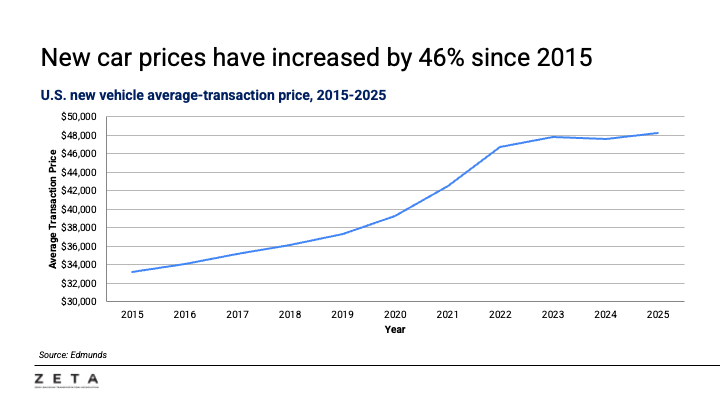
What sort of factors have contributed to this rise? Well, over the past decade, the U.S. has seen supply chain challenges following a series of events, including Russia’s invasion of Ukraine, the Covid-19 pandemic, and the semiconductor chip crisis in 2022. Vehicle inflation has played a factor too, as parts for new cars have become more expensive to manufacture, due to tariffs being placed on everything from battery and vehicle components to a completed automobile. Newer cars are more technologically advanced, which has also contributed to price increases, from the inclusion of more efficient drivetrains and powertrains to the inclusion of advanced-driver assistance systems (ADAS) for safety.
One other major factor that may have contributed to the increase in prices is quite simply consumer preferences. Caldwell pointed this out as a key driving factor: “It was our own demand that led the lineup of new vehicles to look this way. A vehicle today, compared to 2015, is a lot nicer, more technology, more safety… so vehicles are better, it’s just the selection of vehicles is causing this increase of transaction prices that are a lot more.”
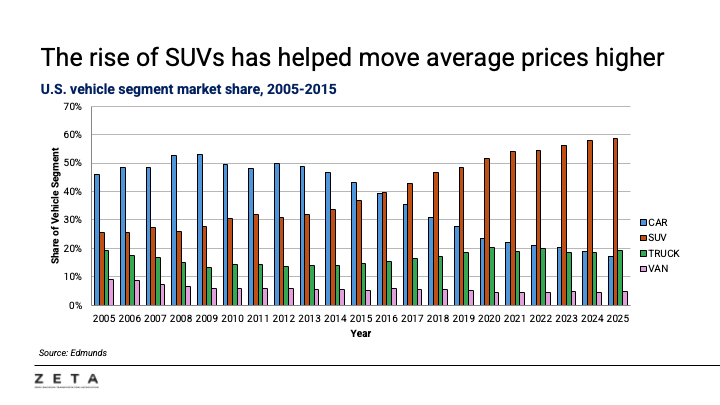
The data backs this up. Two decades ago, according to data provided by Edmunds and highlighted in their 2026 Trends Report, passenger cars made up over 50% of the U.S. new car sales market, while in 2025 they represented only 17%. Meanwhile, SUVs (including crossovers) have seen enormous growth – almost inversely proportional to the demise of passenger cars – approaching nearly 60% last year. The share of pickup trucks has remained fairly consistent for the past 20 years.
Caldwell noted that she believes the SUV shift will be lasting. “SUVs are really here to stay, when you look across the board they exist in so many variants that it’s hard to find one that you’re completely opposed to.” Caldwell listed the fact that consumers like sitting higher up, with a better view of the road and the feeling of security, as well as cargo space as contributing factors.
Given that many of these trends have accumulated over the long term, the question remains: how can the vehicle market become more accessible to more consumers? The data Edmunds shared highlights how the U.S. car market (which is projected to remain around 16 million units sold this year) has become more focused on wealthier consumers across drivetrains.
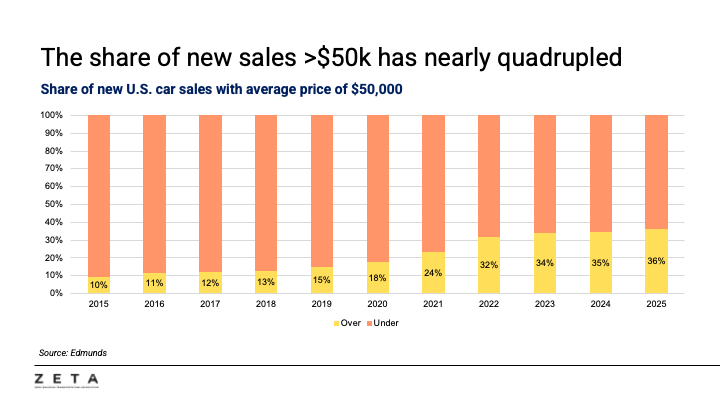
This concept is known as a ‘k-shaped’ economy (or ‘k-shaped recovery’ in some cases). In the case of the automotive market, it means that the growth is being driven by individuals with higher incomes – with sales of premium vehicles increasing (across all vehicle drivetrains). Meanwhile, vehicle sales in the more affordable segments have declined as a share of the market. For example, the share of new car sales in the U.S. below $30,000 fell to a low of 7.5% this past November according to Kelley Blue Book. Conversely, the share of new sales over $50,000 has risen dramatically. Market share of cars in that price category (>$50k) has nearly quadrupled from ~10% in 2015 to 36% last year – demonstrating the growing demand for higher-end vehicles.
Electric vehicles could be a key part of the solution
The data shows that the changes in the auto industry are driven by long-term shifts, with no easy fixes. While automakers are suggesting more affordable models are a priority, products can often take years to actually come to market.
The good news is that more affordable electric vehicles are already on the way. New EV models in 2026, including Rivian’s R2 SUV, the new Slate truck, the recently announced Subaru Uncarted, and the relaunch of the Chevrolet Bolt and Nissan Leaf, will help meet more of the mass market. According to data from Recurrent Auto, the number of new EVs for sale under $42,000 is projected to double from 8 in 2025 to 17 models this year.
This matches a long-term trend. BloombergNEF’s Lithium-ion Battery Price Survey finds that the price of a new EV battery pack has fallen under $100 per kilowatt-hour (overall, the survey found $108 per kWh for all battery usages). These cost reductions, which can ultimately be passed along to consumers through cheaper prices, have allowed the upfront cost of EVs to fall over time.
Caldwell argued in the conversation with ZETA that EVs may be finding a sweet spot in the mass-market segment. “About 64% of EVs transact at or below $50,000,” said Caldwell referring to 2025 data. “If you look at the highest $10,000 threshold, it’s the $30,000 to $40,000 [price range]. So we know there’s demand in that space.” Ultimately, she suggested the real challenge is educating consumers that EVs in this price point exist, convincing consumers that an EV product is worth their investment, and raising brand awareness for lesser-known brands (or hoping that brands with high consumer sentiment introduce more EVs).
Still, the conversations around how to lower vehicle prices are unlikely to reach a speedy resolution. Caldwell shared that prices are unlikely to reverse themselves on an industry-wide average. But automakers are now more attuned to attempting to meet the needs of consumers looking for a mass market vehicle. New electric vehicle models could be poised to play a pivotal part in helping to provide a more affordable option for the millions of Americans who have increasingly found owning a new car out of reach.
Watch the webinar

%402x%20(1).svg)
%402x%20(1).svg)
National policies to support the electric vehicle supply chain.
