


Used Market Provides EV Opportunity In 2026
.avif)
Corey Cantor

Most of the focus on electric vehicle (EV) adoption has been told through the prism of new car sales. Understandably so, as many of the electric cars on the road today only launched in the past decade.
The sales of new passenger EVs reached one million units worldwide in 2017. In the time since, the speed of adoption has scaled up rapidly, with sales in 2025 reaching 21 million units–representing nearly one-quarter of all sales worldwide. The U.S., too, has seen adoption rise rapidly - with millions of EVs added to our fleet over the past decade, and the share of sales growing from 2% in 2020 to 10% in 2024.
U.S. new passenger car sales across the board have hovered around 16 million units over the past two decades. But an equally important and robust marketplace is nearly twice the size of the new car market. I am talking, of course, about the used car marketplace. While sales figures for used car sales are a bit more opaque to measure, used car sales in the U.S. have ranged between 32-40 million sales each year.
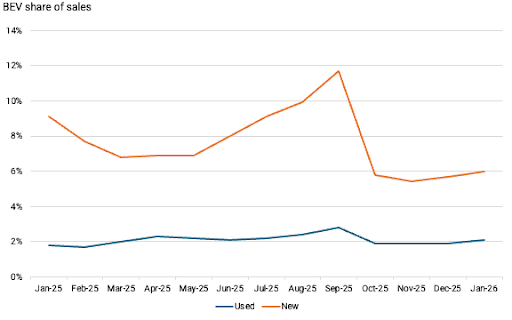
Comparatively, the EV share of sales in the used car market is quite a bit behind new sales. For the past year, market share has hovered between 1.7% and 3% - with a similar spike around the expiration of the used EV tax credit in September 2025. According to data from Cox Automotive, used BEV sales represented around 400,000 units in 2025, which is higher than new BEV sales in any calendar year prior to 2021.
Barriers to adoption, and the case for used EVs
While sales data shows that the used EV market is showing strong signs of growth, there remain barriers to entry for potential customers.
Survey data for used EV ownership is not necessarily as prevalent as for new car sales; this 2023 polling by YouGov elicits some interesting findings on obstacles and opportunities. For example, there is a lot of overlap in the concerns of purchasing a used EV and a new EV, including around range anxiety, upfront cost, and model availability. Customers who are interested in used EVs cite lower maintenance and operating costs as some of the main incentives for buying a used EV, as well as the lower upfront cost of the vehicle relative to the purchase price of a new EV.
Consumers’ concerns are not irrational, though there has been great progress in the EV market that could make buying a used EV more attractive. I have broken down a number of top considerations below.
Upfront cost. Just like new car sales, there are concerns about the upfront cost to purchase a used EV, particularly compared to a hybrid or gas option. According to a new report by Recurrent, the difference between these vehicle types, particularly in the used market, is closing. You can now get a three-year-old used EV that appears quite attractive on an upfront cost basis compared to other drivetrains. For example, if you’re purchasing a used car in the $20,000 - $30,000 price range, you could purchase a 2021 model year (MY) ICE vehicle with nearly 50,000 miles on it (such as a Toyota Camry, Chevrolet Equinox or Toyota RAV4) or a 2022 MY EV with only 33,000 miles on it (like a Tesla Model 3, Model Y or Ford Mustang Mach-E). The EVs are newer, with the ability to update over-the-air, and will cost less to fuel, but launching around the same price.
Battery longevity and health concerns. As noted above, in the YouGov survey, range anxiety is the top-cited concern for purchasing a used EV. Implicitly, this touches on concerns around the EV battery. ZETA recently hosted a virtual conversation with Liz Najman, an analyst from Recurrent, which tracks and analyzes the used EV market. During the conversation, she presented interesting data highlighting EV range over time. After three years, most EV models are on average retaining about 97% of their total original range.
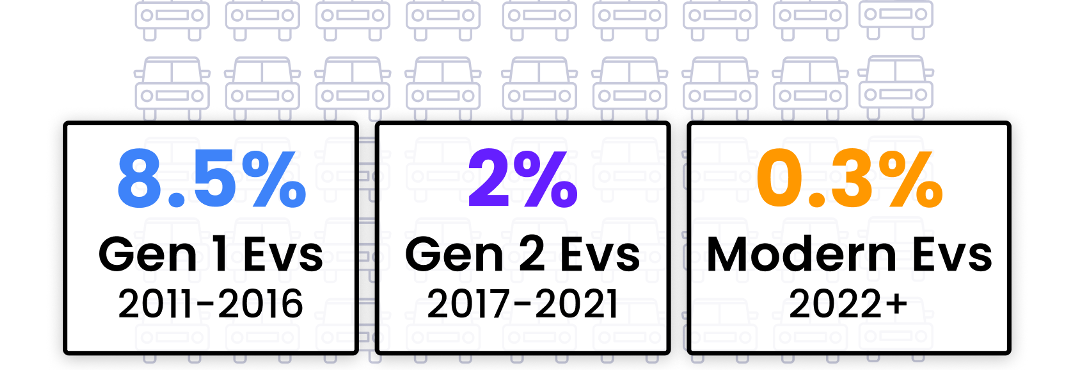
Even more heartening for the used market is the fact that EV battery replacement is extremely low, particularly for EVs sold since 2017. Recurrent’s analysis has found only 2% of EVs from 2017-2021 required replacement (in what they call generation 2 EVs) and only 0.3% of EVs since 2022 have required any battery replacement. EV batteries have warranties of up to 8 years or 100,000 miles, which cover new buyers and many of the EVs that have just come off-lease. It’s possible to also purchase an extended warranty after the initial warranty has run out; Recurrent has a list of provider options for extended warranties. For comparison’s sake, gas cars typically have shorter warranties of around 3-years (36,000 miles), with around 5-years on the powertrain.
Residual values. Perhaps the most tricky question for the used EV market is around residual value of the car. In general, new cars lose value the second they are driven off the lot. Given consumer questions around the EV battery, and the fact that technologies around EVs keep improving, it has not been surprising to see EVs depreciate quickly in these early years of mass adoption. The smaller supply of cars and the high-rate of leasing could also harm EV residual values in the near-term.
Over the longer term, as the product improves and EV battery life continues to outperform expectations, we could see residual values improve. Currently, this metric favors the ‘buyer’ compared to the ‘seller’ who originally buys the car new, as it makes used EVs a highly affordable option.
Maintenance. One clear benefit for used EVs is around comparatively low maintenance costs. Maintenance cost for gas cars is often quite high, given that used cars have years of wear and tear on them. For these used EVs, the maintenance benefits should be almost immediate. Most surveys suggest that EV maintenance is 30-40% cheaper on-average than for internal combustion engine vehicles.
Public Charging. Concerns around public charging have been cited in numerous consumer surveys as a top-tier barrier for new buyers. Yet there is positive news on that front too, as the public charging network has more than doubled since 2021 - to 236,000 public charging connectors. A strong public EV charging network will boost enjoyment for both new and used drivers - a rising tide lifting all boats. Consumer sentiment around the U.S. public charging network continues to improve, as it has reached all time highs in the recently published JD Power EV Ownership Survey.
Model availability. The used EV market was far more limited in 2023, because there were fewer EVs sold in the preceding years and less model variety. Given the higher level of model introductions and EV lease offerings of the past three years, a more robust used EV market may be in the making.
There are other considerations that customers may want to think about when evaluating a used EV. Some good questions to ask can be found in these recent reports by MotorTrend and Consumer Reports.
Long-Term Outlook for Used EVs
Over the longer term, the used EV market should continue to mature as consumers gain more experience with the technology and more vehicles are resold in the used car market.
One thing that should help with the fluctuating used market is the fact that many EVs were leased over the past three years. According to data from Edmunds, the EV lease penetration rate has ranged between 50-80% over the past two years.
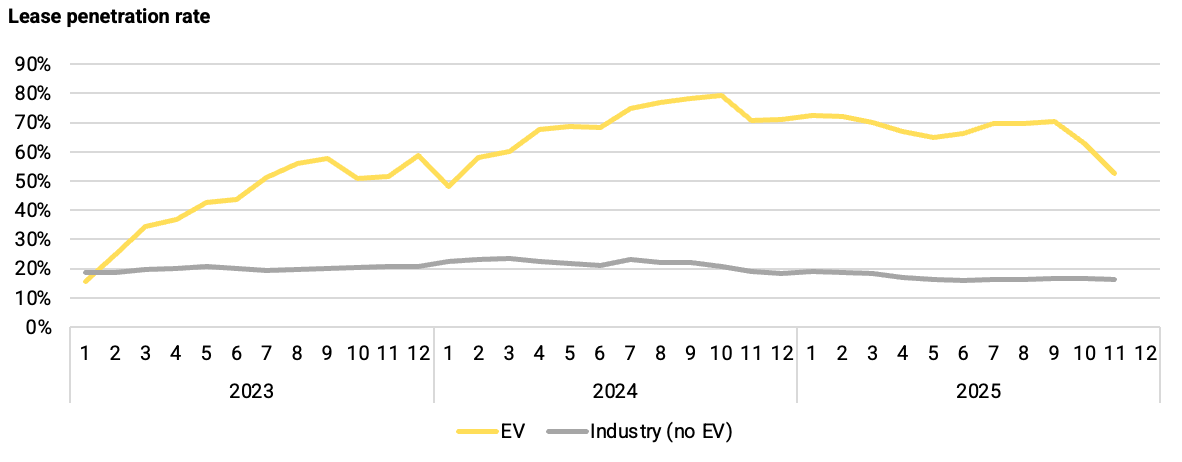
Once the commercial clean vehicle tax credit was ended under the One Big Beautiful Bill Act, the leasing rate began to decline. Still, the typical leasing rate for a gas car is slightly under 20% of the new car sales market each year. Practically, what this means is that the used market should see a surge over the next few years as EVs come off-lease.
As used EV sales are increasing, we are seeing further attention paid to this burgeoning market. New online marketplaces like Plug and Ever are adding transparency around used EV prices and sales. This can help dealers who handle the bulk of used EV transactions as they navigate the steady increase in off-lease EVs.
Recurrent expects up to 500,000 EVs to come off lease in 2026, with nearly double that possible in 2027. Consumers and sellers will have to grapple with a rapidly growing supply of these vehicles and its market implications. But this may open the door to a new market that can reach millions of Americans who are looking for an affordable option for their next vehicle.

%402x%20(1).svg)
%402x%20(1).svg)
National policies to support the electric vehicle supply chain.
