


Commercial EVs are entering the market at a critical moment
.avif)
Corey Cantor

ACT Expo 2026—which wrapped up earlier this month—presented an exciting opportunity to view the latest developments in electric passenger and commercial vehicles. This year’s conference came at a pivotal moment, as the light-duty EV market entered a new phase and medium- and heavy-duty EVs finally arrived on the scene in a serious, comprehensive way.
The ACT Expo takes a fleet-focused approach, with speakers and participants representing various aspects of fleet transport and related infrastructure deployment. Mainstage speakers represented some of the largest fleet operators, including executives from many ZETA member companies like Tesla, Rivian, LG, and ABB E-mobility, among others. More than 8,000 attendees attended this year’s expo, including 350 speakers and 400 exhibitors.
As a part of the conference, I presented on the state of the EV market, with a particular focus on fleets. My key takeaway? The market is changing and ripe for disruption, meaning new approaches can lead to smart innovation and ultimately positive results. To emphasize the importance of disruption, I used the story of how rock band Coldplay was encouraged by famed producer Brian Eno to switch their approach, and that this innovation led to their most acclaimed album.
Here are a few high-level data points from the presentation:
Commercial EV sales are on the rise.
We’ve shared statistics before about the proliferation of passenger EVs both in the U.S. and across the globe. Last year, passenger EVs represented nearly 25 percent of all new car sales globally, sailing past 20 million units – across battery-electric and plug-in hybrids. This progress didn’t happen overnight, as falling EV battery pack prices allowed OEMs to lower the cost of EVs over time, with adoption rising as the vehicles themselves became more affordable.
The same global story is playing out with medium- and heavy-duty electric vehicles.

Sales of medium- and heavy-duty EVs reached nearly 50,000 in 2Q 2025, an increase of 665 percent from approximately 6,250 units in 2Q 2022.
The Global Competition is On.
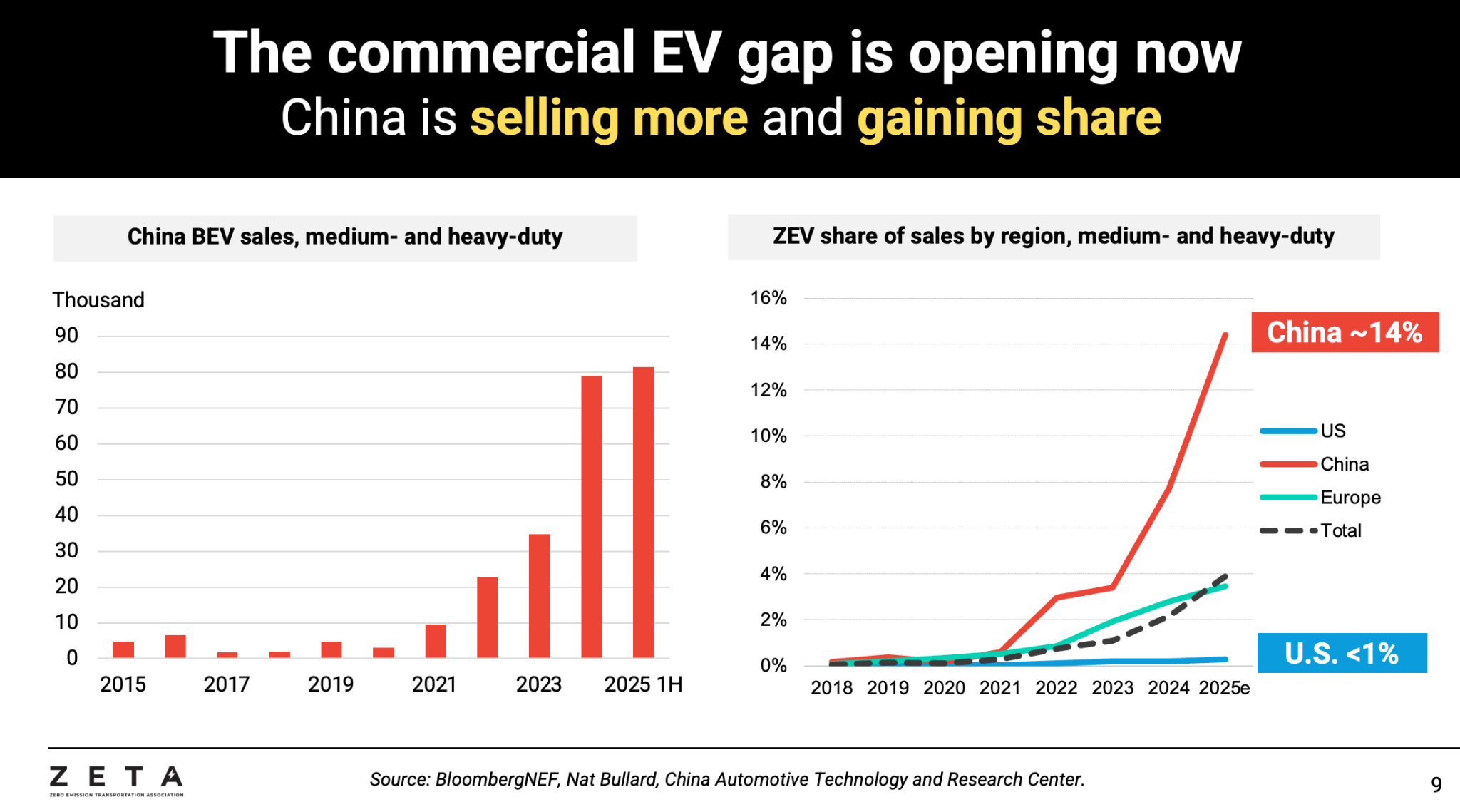
Despite the positive global growth in medium- and heavy-duty electric vehicles, this segment is also seeing strong deployment by Chinese automakers. China has already seen explosive growth in the passenger car space, going from producing less than 2 percent of global passenger car volume in 1999 to over 40 percent in 2025.
In China’s market, the share of zero-emission vehicles in the medium- and heavy-duty space has risen from less than 2 percent in 2021 to an estimated 14 percent in 2025, according to a report focusing on commercial vehicles published by BloombergNEF. Meanwhile, in Europe and the U.S., the share of new medium- and heavy-duty vehicles that are zero-emission is far less at 4 percent and ~1 percent respectively.
Without strong effort by the private sector and policymakers, medium- and heavy-duty vehicles may see a similar pattern play out as in the passenger car space, where despite all countries starting with similar electric penetration, the lack of federal investment puts the U.S. at a disadvantage. If the U.S. is unable to compete, Chinese automakers will gain a strong position and strengthen its hold on the supply chain as well as the global market.
The case for fleet electrification is strong.
The good news for the U.S. and other countries is that there is a clear and positive case for fleet electrification. The total cost of ownership (TCO) benefits of electrification offer fleet operators a fundamental economic case for adopting more EVs, as the fueling cost of electricity is far less than gasoline and EVs require less maintenance. Many commercial vehicles operate on diesel as well, which has an even-higher cost in today’s environment. According to AAA, the latest average price for regular unleaded gasoline nationally in the U.S. was around $4.52, while diesel hit $5.63 on May 18, 2026.
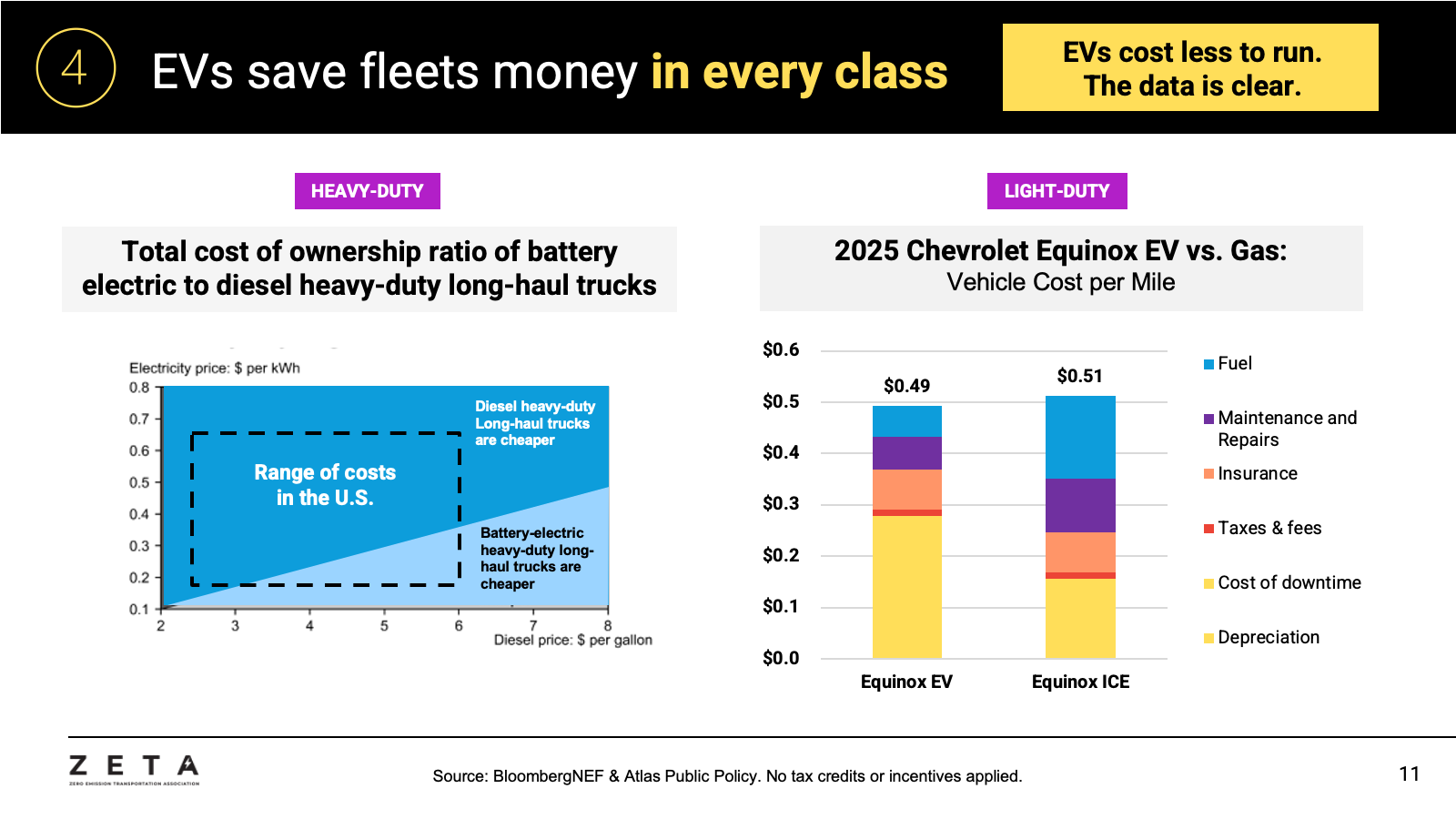
Given that commercial fleets deploy many vehicles, the savings on each individual vehicle multiplies over its lifetime on a per mile basis and across the fleet. What may start as an incremental TCO-positive benefit for electric vehicles over a comparable ICE vehicle in the near-term, may represent more significant savings per vehicle over the long-term. Many fleet vehicles end up driving far more annually compared to the average passenger driver. These TCO benefits extend to the most potentially challenging sector to electrify: long-haul heavy-duty trucks. The electric variants have become more cost competitive, especially with elevated diesel prices.
Furthermore, there are also thousands of dollars saved in maintenance costs by switching to EVs, as they see less wear and tear of individual parts in most cases compared to ICE vehicles. Inspiration Mobility, one of ZETA’s members, shared how some of their fleets also benefit from the lack of vehicle downtime in later years for routine maintenance like oil changes – this is valuable time accrued during which vehicles are able to continue operating and benefitting the fleet operators economically.
There are other positive trends that impact the commercial EV space that were touched on in my presentation, including the rise in commercial EV-focused charging investment, state public policy and the importance of private sector investment in the supply chain.
The ACT Expo Show Floor Highlighted Many of the Benefits of Electrification
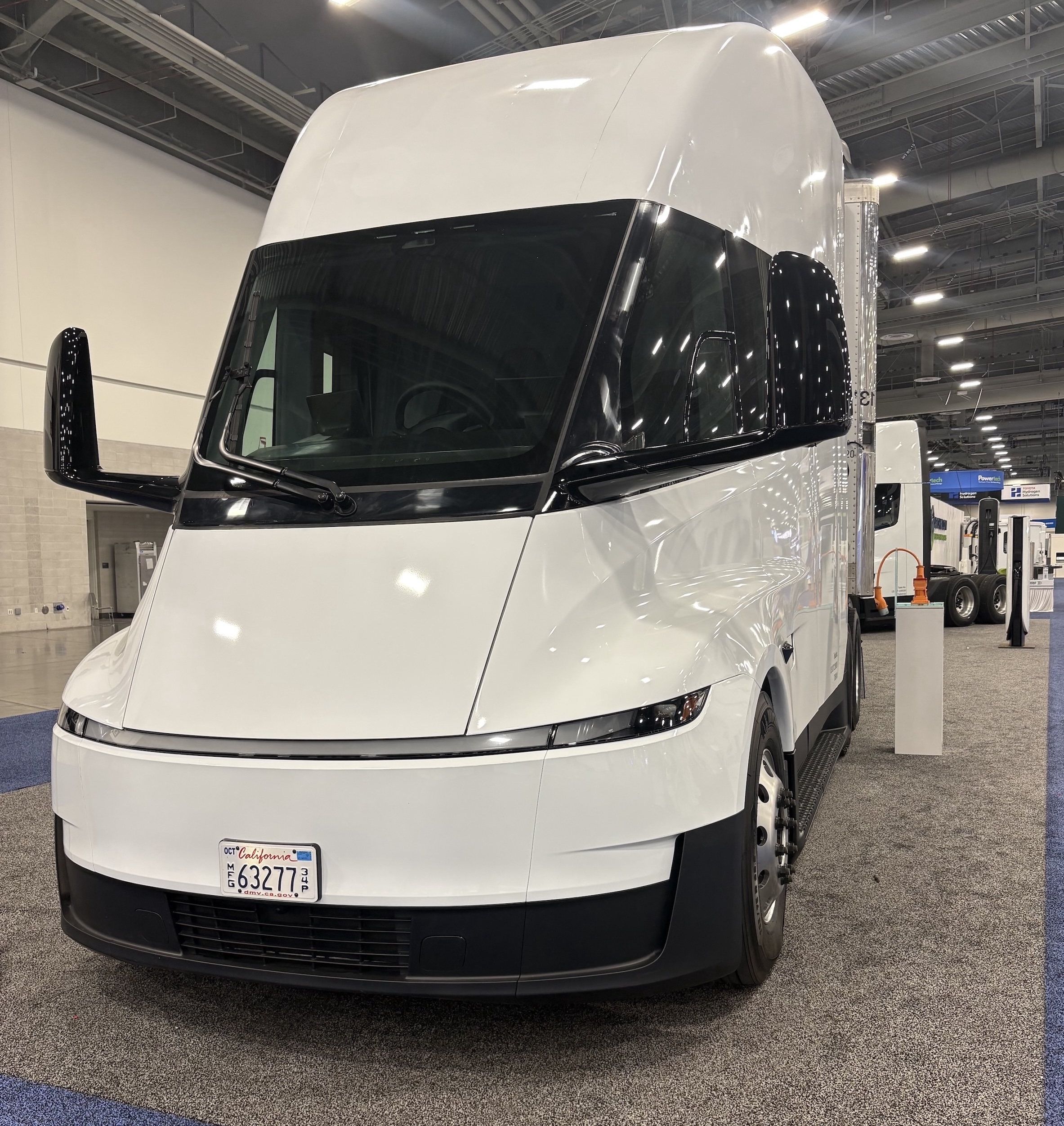
Of course data and research, while important, are only one part of this commercial EV fleet story. The Expo Show Floor at ACT Expo offered a myriad of impressive new products and commercial fleet suppliers aiming to make their marks.
Immediately noticeable was the variety of massive heavy-duty electric trucks on display. ACT represented the public unveiling of the redesigned Tesla Semi, which was the main draw at Tesla’s booth. The new Semi is the production unit that is shipping later this year to customers as the Nevada facility ramps up. As opposed to a traditional internal combustion engine (ICE) class 8 truck, the Tesla Semi positions the driver at the center of the cabin, and offers a potential co-pilot seat for another person behind. Tesla’s design team was also really receptive to driver feedback, aiming to make the truck really work for the user. There were other companies offering heavy-duty electric truck options, including Harbinger Motors, Volvo Trucks, and Orange EV.
There were other commercial EVs of many different types also situated across the show floor. Electric school buses, shuttle buses, box trucks, and delivery vans were on display. Rivian brought the R2, which as we’ve shared previously is set to ship to customers next month. Several fleet suppliers focused on medium- and heavy-duty charging were on display too, highlighting how they could meet the high-powered needs of these commercial vehicle customers.
With the doors now closed on the expo hall, the efforts of all the companies that attended ACT Expo will continue to make their imprint on the automotive industry. Just as in the early days of light-duty electric vehicles, success is not guaranteed for any particular drivetrain or specific company product.
But the main takeaway was crystal clear: disruption is coming for the commercial vehicle space, and it’s coming quickly. You might see it on public roads near you sooner than you think.

%402x%20(1).svg)
%402x%20(1).svg)
National policies to support the electric vehicle supply chain.
