


Ride-Hailing Paves the Electric Speedway
.avif)
Corey Cantor

Electrified transportation is making its way through the automotive industry at different speeds. While much of the focus has been on private passenger vehicles, EV adoption has actually been faster for Transportation Network Companies (TNC), like Uber and Lyft.
TNCs use ride-hailing services, which allow riders to enter a destination in a mobile application, be matched with a driver, and be dropped off at their desired location. With a variety of drivers and their available vehicles in the application, this provides a unique opportunity for TNCs to enable both drivers and passengers to experience electric vehicles firsthand. For some riders, ride-hailing may be their first opportunity to experience the comfort, speed, and technology that only EVs can offer. Ride-hail drivers, meanwhile, are often concerned about the cost of operating their vehicle while aiming to maximize their financial benefit during their shifts—EVs can lower some costs, which can increase their take-home pay.
Despite these benefits, there are challenges to overcome for the TNC sector to accelerate electrification. This post will explore the growth of EV usage for TNCs, the benefits of electrification for the sector, and policies that can increase adoption moving forward.
Growth of electric usage in TNC
According to BloombergNEF’s (BNEF) Electric Vehicle Outlook 2026, shared mobility (including TNC drivers and conventional taxis) made up around 4.4% of all vehicle kilometers traveled globally in 2025, though in some markets like India ride-hailing made up around 23% of distance traveled by the electric vehicle fleet. BNEF expects the global use of shared mobility to rise to around 8% globally by 2040.
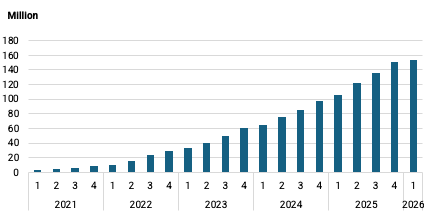
The upward trend in the usage of zero-emission vehicles (ZEV) for ride-hailing is apparent. Over the past five years, Uber’s ZEV trips on a quarterly basis have grown more than fifty-times from 3 million trips in Q1 2021 to 154 million in Q1 2026.
Uber Total Zero-Emission Vehicle Ride-Hailing Trips by Quarter
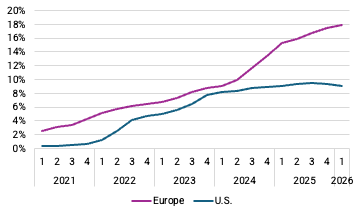
According to Uber’s Quarterly Electrification Update, the share of ZEV miles-traveled is very much on the rise. Over a five-year period, ZEV share rose in the U.S. from 0.3% in Q1 2021 to 9.3% in Q1 2026. Uber’s ZEV share growth in Europe is even more dramatic, rising from 2.6% in Q1 2021 to 17.9% in Q1 2026. With the recently elevated oil prices due to conflict in the Middle East, Q2 2026 could see even higher ZEV mileage in Uber’s electric fleet. Data shared by the company indicated that the U.S. reached a new high of 10% ZEV miles traveled in May 2026. Europe saw a new record too, hitting a 19% ZEV-miles traveled share. According to Uber, one-in-four riders says that their first-ever EV ride was in an Uber vehicle, which means the higher electric mileage can have a positive spillover effect for passenger exposure to EVs.
Share of miles traveled by Zero-Emission Vehicles by Uber Drivers
Outside research sees a similar rise in the use of EVs for ride-hailing. BNEF’s research suggests that in the major markets of China, Europe, and North America, the ZEV share of distance traveled is far higher for TNCs than for private vehicles. For example, in 2025, BNEF found that private vehicles in North America had a ZEV share of distance traveled at around 3%, compared to nearly 10% for Uber drivers. China saw a seven-times higher EV share of distance traveled for TNC drivers by the Chinese ridehailing company Didi, at 70%, compared to all private vehicles. China’s ride-hailing market alone has nearly 4 million EVs, with vehicle models adapted to the needs of TNC drivers and passengers in the country.
Autonomous vehicle (AVs) companies like Waymo, Tesla and Zoox are also players in the ride-hailing space, offering fully electric robotaxis to consumers as a transport option, and Uber has AV deployment deals with Lucid, Rivian, and many other AV players. While AVs comprise less than 1% of the ride-hailing market activity to-date (in terms of miles-travelled), they are expected to grow in the future. ZETA will cover autonomous electrification in a future publication.
Benefits and challenges of driving electric for TNC drivers
TNC drivers—like all drivers—see real benefits from switching over to electric vehicles, such as reduced fuel and maintenance costs. There are also real challenges the market needs to address to make electrification more accessible.
Benefits for Drivers
Vehicle economics. For many commercial and individual customers, the choice of vehicle comes down to simple economics. The upfront cost of a vehicle is important to traditional consumers, but many also consider the total cost of ownership (TCO) to inform their purchasing decisions. Given the high mileage that many TNC drivers undertake, the TCO benefits of electrification are stark.
Electricity remains a cheaper fuel option than gasoline, with savings that add up the more you drive. Still, the overall economic benefit for TNC drivers will depend on how and when they charge. While our analysis suggests a strong benefit at the average electric charging price over the average gas price, TNC drivers will see even better savings if they have access to low-cost Level 1 (L1) or Level 2 (L2) charging. Other key elements that drivers should consider is the upfront cost of the vehicle and differences in other operating costs, like maintenance – EVs have been shown to require significantly less maintenance.
How do all of these economic considerations add up for a TNC driver? On average, a TNC driver drives around three-times as many miles annually as the average U.S. driver. For the sake of our analysis, let’s assume around 40,000 miles per year.
The recent national average for home charging is around 13 cents per kilowatt-hour, while fast charging is closer to 42 cents per kilowatt-hour according to AAA. We analyzed two scenarios. One with slow-charging and fast-charging is split equally. The other uses a split more like private drivers (80% of EV charging done on L2 charging). In both scenarios, a TNC driver saves money. Still, reducing fueling costs through heavier use of L2 charging can save thousands of dollars.
Total Cost of Ownership Comparison of TNC drivers
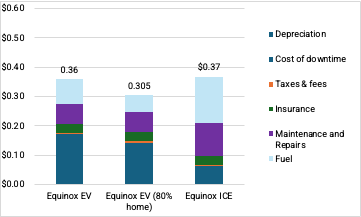
Note: TCO analysis assumes the price of gasoline is $4.06 per gallon, $0.42 per kWh (fast-charging), and $0.13 per kWh (home-charging), annual mileage of 40,000 per year for six years. Analysis was completed in early June 2026.
For example, an electric Equinox used for ride-hailing (split equally between L2 and fast-charging) would cost around $0.36 per mile, compared to $0.37 per mile for an internal combustion engine (ICE) Equinox. Meanwhile, an EV Equinox that uses more L2 charging could see a cost reduction of $0.305 per mile. Over six years, that could result in nearly $15,000 dollars in the TNC driver's pocket at $0.305 per mile, compared to an ICE Equinox.
Premium vehicle offerings. Electric vehicles are comfortable and tech-heavy, with numerous safety features available right after purchase. TNC drivers have cited EVs' ability to perform over-the-air updates as an attractive feature. They also appreciate that EVs offer customers premium services that they may desire. The smooth ride and improved handling of an EV, given its vehicle aerodynamics and its low center of gravity, are also a potential reason that most drivers (including TNC) have enjoyed driving an EV after making the switch.
Scale-up challenges
EV charging. As with all electric vehicles, the question around where and when to charge them is paramount for TNC drivers. When electricity prices are low, often at night, it can help TNC drivers put money back in their pockets by minimizing their costs. Many drivers may not have access to a home charger, however, so a reliable public charging network is also critical to ensure that downtime for drivers remains limited. For example, Lyft offers drivers discounts on home chargers through a partnership with Wallbox, saving them money on hardware, while offering incentives with public charging networks like EVgo and Electrify America. Uber has a similar partnership with EVgo and Revel, where drivers at certain levels can receive discounts when charging publicly.
A BNEF report co-published with Uber in 2024 focused on ride-hailing in Europe highlighted some additional challenges around EV charging for drivers. Essentially, the report concludes that TNC drivers “are also more price sensitive than the average driver as BEV ride-hailing drivers are essentially forgoing potential revenue while searching for public chargers, queuing and waiting for their vehicles to charge.” In short, there is an opportunity cost of waiting too long that should be added to any idling, and why improving both driver access to public fast and low-cost overnight charging is critical.
In November 2025, Cadmus published a white paper supported by industry on ridehailing electrification. In it, they note that many barriers to TNC adoption stem directly from limited access to EV charging. In the paper, they emphasize the importance of deploying curbside charging, low-cost EV charging tariffs, and make-ready programs for charging installations to improve the overall charging experience for drivers.
A newly published study in Transportation Research (Iogansen, Giller, et al) highlights the importance of improvement in public EV charging noting: “Access to public chargers had a statistically significant impact on the adoption of BEVs among those with ridehailing intentions. Vehicles acquired with ridehailing intentions are likely to be used primarily for ridehailing work, for which access to public chargers is crucial for charging during shifts.”
Upfront cost. Just as for private car owners, TNC drivers have found that the upfront cost of electric vehicles can be a barrier. According to UC Berkeley Transportation Sustainability Research Center and the Center for Sustainability Energy, upfront price is commonly cited as one of the top barriers for TNC driver adoption. Currently, the average price of a new car in the United States is around $50,000, which has led to a slowing in sales and increased attention paid to the production of more affordable models across all drivetrains.
TNC drivers are more price sensitive than a typical private vehicle owner, so vehicle purchase price can have a significant impact (particularly with many popular vehicles for ridesharing like the Toyota Corolla Hybrid starting around $28,000). Uber has recently provided drivers with a $4,000 grant to address the upfront cost of EVs.
Another potential solution is the rise of used EVs, which has seen strong growth over the first half of 2026. The upfront cost difference between a used EV and used gas car is narrowing, with the Autopian noting that the monthly difference on average is only about $20. A growing number of off-lease EVs are entering the used market following only two- or three-years of use that may be appealing to TNC drivers.
Model availability remains limited. It’s clear that the U.S. is seeing far stronger EV model availability than even a few years ago given the increased offerings produced by automakers. Still, models that ride-hail drivers look for may have certain traits that differ from vehicles popular with traditional drivers. Typically, TNC Drivers will want models that are affordable upfront, easy to repair, and spacious.
While model availability has improved for the EV market overall, more mass market new EVs below $40,000 would benefit the TNC driver network. Currently, many of the vehicles utilized by these drivers sit at lower price points. For example, BloombergNEF’s Intelligent Mobility Team shared data on New York City highlighting how Toyota was the favored OEM of choice for the city’s for-hire drivers – 48% of all of these for-hire cars were of the Toyota brand. Tesla’s Model Y was the most popular electric ride-hailing offering, making up 6% of all vehicles in the data set. Increasing the number of models available across vehicle classes, particularly at the mass market level, will be necessary to attract more drivers to EVs.
Policies that can increase TNC EV adoption
While policy focused on increasing EV adoption for TNC drivers has not been a particular focus at the federal level, there are states and municipalities that have aimed to increase adoption in this area. The policies put in-place to date have focused on encouraging more ZEV drivers through carrots (i.e. incentives) or sticks (ZEV-only targets). Some examples of policies include:
Massachusetts Clean Energy Center’s (MassCEC) “Ride Clean Mass” Program. Massachusetts has implemented a fleet electrification program, aiming to increase EV adoption for both rideshare and taxi drivers. In total, Uber and Lyft drivers can receive up to $14,000 off of a new EV, or $6,500 towards a used EV. Taxi drivers see even more savings at $17,500 for a new EV. Only fully electric vehicles are eligible for this program, so plug-in hybrids and conventional hybrids are not eligible for a subsidy. Taxi drivers and delivery fleet operators can use the program multiple times, but TNC drivers may only receive the incentive once.
In total, the program has awarded more than 300 rebates for TNC drivers, and is designed in partnership with companies like Uber and Lyft to ensure the recipients are certified. The subsidy amount was raised in March 2026 to help close the gap created by the expiration of the federal 30D Clean New Vehicle tax credit. Additional changes are forthcoming for the program, including converting the incentive to a point-of-sale rebate, which may increase program utilization. Ride Clean Mass is administered by the MassCEC, in collaboration with CALSTART.
Colorado’s Clean Fleet Transportation Network Companies Grant Program. Colorado has long been a proponent of policies around TNC and clean fleets, including previous incentive programs aimed specifically at this sector. The state is currently revising its TNC grant program, with updates expected by 2027. Colorado currently has two grants running with Uber and Lyft for a total of $3.1 million, which allows the companies to offer their TNC drivers funds depending on the number of electric drives a TNC rider performs. In 2027, Colorado will evaluate if this per-trip incentive is working, and is planning to introduce a new upfront rebate similar to Ride Clean Mass, as well as looking into offering an assistant service for TNC drivers in order to help them go electric. Thus far, the program has given out 4,100 grants that have resulted in over 4.1 million electrified ride-hailing miles.
New York City’s “Green Rides” initiative. Under NYC’s transportation initiative, passed in 2023, the city aims to have 100% of all TNC drivers and taxi rides by 2030 as zero-emission or wheelchair accessible. This year, the initiative aims for 25 percent of all high-volume for hire trips in 2026 to be zero-emission or wheelchair accessible. As of April 2026, only around 14% of all rides were electric, highlighting that there remains a gap between the actual electric usage and the goals of the city over the long-term.
London’s Ultra-Low Emission Zone. In London, the city utilizes a specific type of congestion charge called an ‘Ultra Low Emission Zone” (ULEZ). The policy charges a fee of £12.50 on all vehicles that enter the ULEZ if they produce tailpipe emissions (with the exception of set hours / time periods). Given that electric vehicles have no emissions, they are exempt from this charge. BNEF has highlighted the importance of these tax exemptions to make the economics for EVs even more favorable given that TNC drivers will often travel into the ULEZ and, if using an ICE vehicle, be required to pay the fee.
TNC electrification outlook
The automotive sector is not one-size fits all, with consumers and businesses using their vehicles for different purposes. TNCs offer one of the best early avenues to increase EV adoption, with potential spillover benefits that can further accelerate adoption overall.
While the adoption of EVs for shared mobility won’t happen overnight, TNC electrification is already outpacing market averages. Real challenges remain in reducing cost for TNC drivers, increasing offerings of ride-hailing model availability and expanding public charging to meet their high-mileage needs. Still, there is a lot of opportunity ahead for TNC electrification. Innovative and ambitious policies are in place in some key markets, and overall the fundamental economic benefits of electrifying remain clear. The world is moving quickly towards electric vehicles – and TNC drivers are moving even faster.

%402x%20(1).svg)
%402x%20(1).svg)
National policies to support the electric vehicle supply chain.
